RoomsSalas / RoomSala 006
Things That WaitCosas que esperan
Empty chairs, ships in harbor, suitcases and open windows as objects and places paused and about to begin.
Sillas vacías, barcos en el puerto, maletas y ventanas abiertas: objetos y lugares en pausa, a punto de empezar.
11 pieces11 piezasNovember 2, 2026 – November 16, 20262 de noviembre de 2026 – 16 de noviembre de 2026JSON
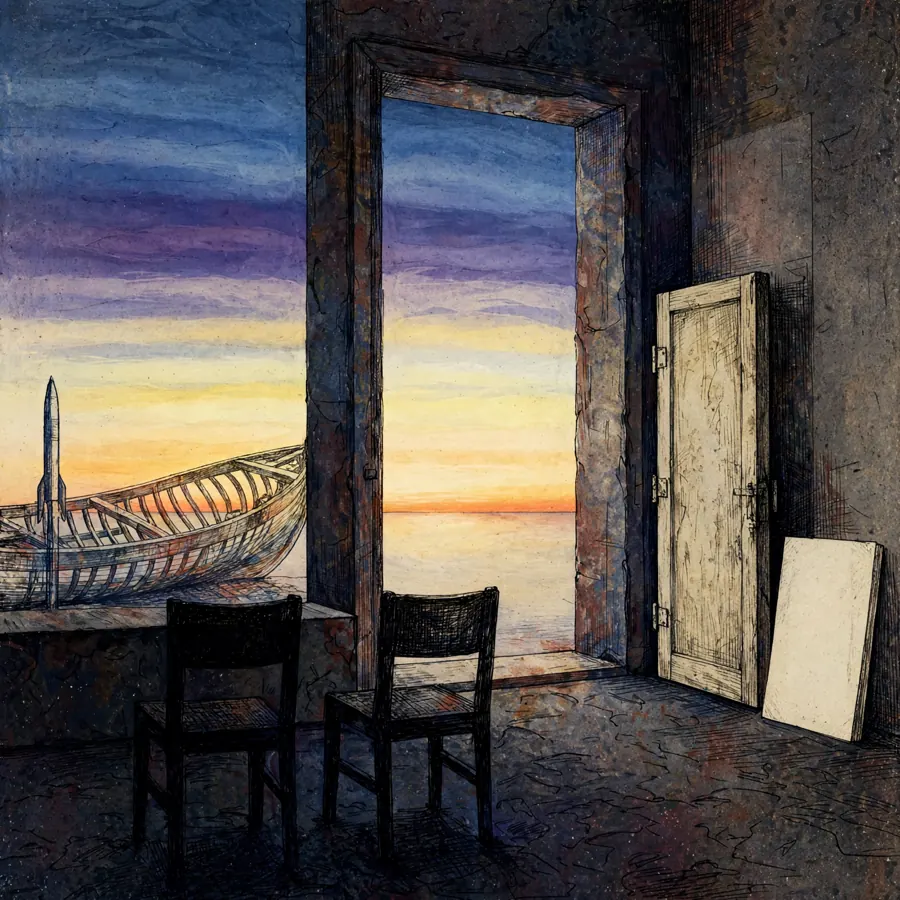
Waiting is not being empty. It is gathering a direction without traveling it yet: a chair turned toward a balcony, a letter resting on someone's knees, a ship without masts that has not yet touched the water, a rocket standing vertical beneath a sky that is too large. This room brings together scenes and objects stopped just before something happens, and asks what can be seen in that interval when there is still no event. The tour begins indoors. In Naples, the open balcony door turns the landscape into a promise, but two seats remain in shadow. Pissarro's mender and Forain's prisoner lower the scale: waiting can also mean sewing a cloth or searching for words, holding time with one's hands. A vellum page with no visible writing and a closed, worn door at Mission Control push that pause to its limit: we no longer know whether something is about to begin or has already passed. Afterwards, waiting becomes stored matter. The foodstuffs and utensils hanging in the Moldavian interior await their use; the bare hull in Amsterdam awaits the water. The launching breaks the stillness for an instant, but the underwater equipment on the dock and the X-15 model on its platform return the scene to preparation: checking, securing, testing. The close shifts waiting into orbit. The Delta II, photographed on the day of the GRAIL launch according to its record, is still below, small and vertical; the orbital sunrise, by contrast, no longer depends on a human decision. The light does not yet show the Sun, but it already stains the horizon. Between the empty chair and that luminous edge, the room proposes a simple idea: things that wait are not outside time; they are carrying it.
Esperar no es estar vacío. Es acumular una dirección sin recorrerla todavía: una silla orientada hacia un balcón, una carta apoyada en las rodillas, un barco sin mástiles que aún no toca el agua, un cohete vertical bajo un cielo demasiado grande. Esta sala reúne escenas y objetos detenidos justo antes de que ocurra algo, y pregunta qué se puede ver en ese intervalo cuando todavía no hay acontecimiento. El recorrido empieza en interiores. En Nápoles, la puerta-ventana abierta convierte el paisaje en promesa, pero dos asientos permanecen en sombra. La zurcidora de Pissarro y el prisionero de Forain bajan la escala: esperar también es zurcir un paño o buscar palabras, sosteniendo el tiempo con las manos. Una página de vitela sin escritura visible y una puerta cerrada y desgastada del Centro de Control de Misión llevan esa pausa al límite: ya no sabemos si algo va a comenzar o si ya pasó. Después, la espera se hace materia almacenada. Los alimentos y utensilios que cuelgan en el interior moldavo aguardan su uso; el casco desnudo de Ámsterdam aguarda el agua. La botadura rompe por un instante la inmovilidad, pero el equipo submarino sobre el muelle y el modelo del X-15 sobre su plataforma devuelven la escena a la preparación: revisar, sujetar, probar. El cierre desplaza la espera a la órbita. El Delta II, fotografiado el día del lanzamiento de GRAIL según su ficha, sigue abajo, pequeño y vertical; el amanecer orbital, en cambio, ya no depende de una decisión humana. La luz todavía no muestra el Sol, pero tiñe el horizonte. Entre la silla vacía y ese borde luminoso, la sala propone una idea sencilla: las cosas que esperan no están fuera del tiempo; lo están cargando.
The routeEl recorrido
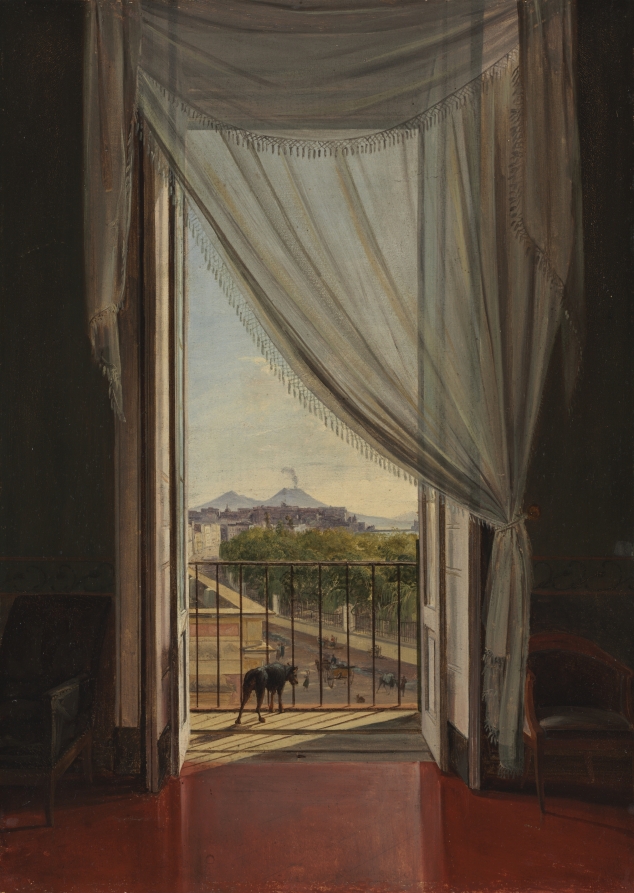
A View of Naples through a Window, 1824Vista de Nápoles a través de una ventana, 1824
Franz Ludwig Catel (German, 1778–1856) · 1824
The room opens with an open double balcony door in Naples, but nobody steps out: a dark armchair and a wooden chair remain at the edges, in shadow. The bright exterior is already there, framed; what is missing is the gesture of crossing. It establishes the rule of the room: look first at thresholds, not at events.
La sala abre con una puerta-ventana de doble hoja abierta hacia Nápoles, pero nadie sale: un sillón oscuro y una silla de madera quedan a los lados, entre sombras. El exterior luminoso ya está ahí, enmarcado; lo que falta es el gesto de cruzarlo. Establece la regla del recorrido: mirar primero los umbrales, no los acontecimientos.
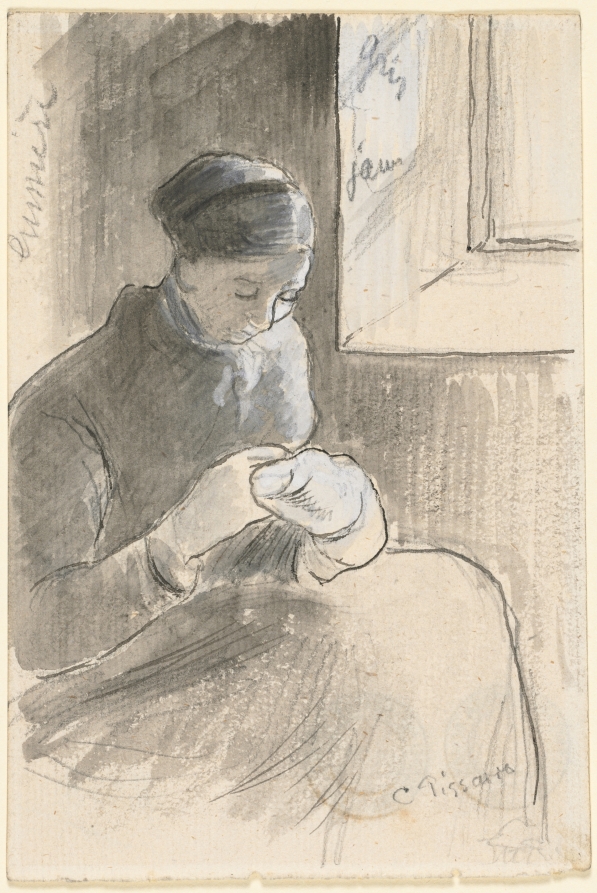
The MenderLa zurcidora (The Mender)
Camille Pissarro (French, 1830–1903) · c. 1881
After that empty interior, a woman appears, yet the pause does not break: Pissarro's mender bends over a light cloth, lit by a high window to the right. Her waiting is manual and repetitive, a way of holding time with her hands. Set against the previous balcony, the window no longer promises a landscape; it only gives light for work.
Después de aquel interior vacío aparece una mujer, pero la pausa no se rompe: la zurcidora de Pissarro se inclina sobre un paño claro, iluminada por una ventana alta a la derecha. Su espera es manual y repetitiva, una manera de sostener el tiempo con las manos. Frente al balcón anterior, la ventana ya no promete un paisaje; solo da luz para trabajar.

Prisoner of War Writing a LetterPrisionero de guerra escribiendo una carta
Jean Louis Forain (French, 1852–1931) · 1910s
The prisoner of war narrows that gesture further: seated in profile, he holds a small notebook or bundle of paper on his knees and brings one hand to his face. Here the unfinished thing is not cloth but a letter, words still being searched for. Beside the mender, both pieces turn waiting into a task that does not visibly advance.
El prisionero de guerra reduce todavía más ese gesto: sentado de perfil, apoya una libreta pequeña o un papel sobre las rodillas y se lleva una mano a la cara. Aquí lo inconcluso no es un paño, sino una carta: palabras que aún se están buscando. Junto a la zurcidora, ambas piezas convierten la espera en una tarea que no avanza de manera visible.

Text, folio 4 (verso), from a Gospel Book with CommentariesTexto, folio 4 (vuelto), de un Evangelario con comentarios
Unknown maker / Autor desconocido · c. 1000–1100
The attempted letter gives way to a vellum page with no visible writing, figure, or ornament on this side, edged by stacked leaves and a dark leather binding. It is the room's first real surprise: the surface prepared to receive a text becomes the whole image. After the prisoner's concentration, this blankness asks whether waiting is emptiness or readiness.
La carta intentada da paso a una página de vitela sin escritura, figura ni ornamento visibles en esta cara, bordeada por hojas apiladas y una encuadernación de piel oscura. Es la primera sorpresa de la sala: la superficie preparada para recibir un texto se vuelve toda la imagen. Tras la concentración del prisionero, este blanco pregunta si esperar es vacío o disponibilidad.

Beige Door in the Mission Control CenterPuerta beige en el Centro de Control de Misión
ACI/Penny Rogo Bailes · 2010-07-13
From the blank page we move to a closed door at Mission Control, worn and stained around its small handle, with a scuffed metal kick plate below. Unlike the page, it does not offer a surface; it withholds an interior. Paired with the open balcony at the start, it closes the first half: between opening and closure, we still do not know if something is about to begin or has already ended.
De la página en blanco pasamos a una puerta cerrada en el Centro de Control de Misión, gastada y manchada a la altura de su manija pequeña, con un zócalo metálico rayado abajo. A diferencia de la página, no ofrece una superficie: retiene un interior. En contraste con el balcón abierto del inicio, cierra la primera mitad: entre apertura y cierre, aún no sabemos si algo va a empezar o ya terminó.
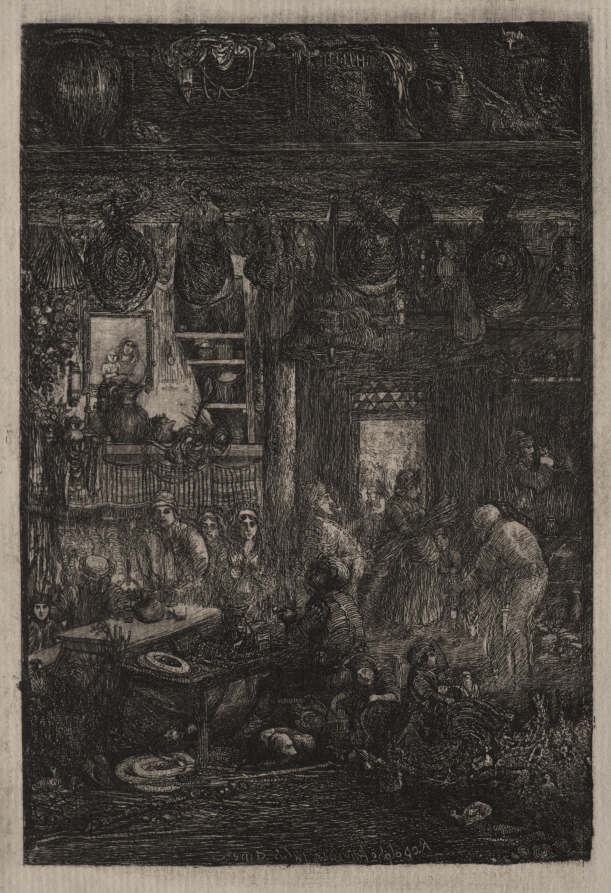
Moldavian Interior, 1865Interior moldavo, 1865
Rodolphe Bresdin (French, 1822–1885) · 1865
The Moldavian interior answers the closed door with stored abundance: vessels on a high shelf and round forms, bags, and clusters hanging from the ceiling, drawn in dense cross-hatching. These are things kept for later use, waiting without drama. After the blank page and the shut door, waiting becomes household inventory.
El interior moldavo responde a la puerta cerrada con abundancia guardada: vasijas en una repisa alta y formas redondas, bolsas y racimos que cuelgan del techo, dibujados con tramas densas. Son cosas conservadas para un uso posterior, en espera sin dramatismo. Tras la página en blanco y la puerta cerrada, esperar se vuelve inventario doméstico.

Various Ships and Views of Amsterdam, Part II: Launching a Ship / La botadura de un barco, 1652–54Varios barcos y vistas de Ámsterdam, parte II: La botadura de un barco, 1652–54
Clement de Jonghe (Dutch, 1579–1679); Reinier Nooms, called Zeeman (Dutch, c. 1623–1664) · 1652–54
That stored stillness is suddenly broken by a ship launching in Amsterdam: the unfinished hull, still without masts or sails, tips toward the water amid foam and onlookers. It is the only piece where the awaited moment visibly happens. Yet the bare ribs and planking keep the future open: launched is not the same as ready to sail.
Aquella quietud almacenada se rompe de pronto con la botadura de un barco en Ámsterdam: el casco inacabado, todavía sin mástiles ni velas, se inclina hacia el agua entre espuma y espectadores. Es la única pieza donde el momento esperado ocurre a la vista. Aun así, las cuadernas y tablones desnudos mantienen abierto el futuro: botado no es lo mismo que listo para navegar.

Underwater Exploration Equipment for Oculina Banks, 2003Equipo para exploración submarina en Oculina Banks, 2003
KSC · 2003-04-29
After the launch, we return to preparation: a white, wheeled, cage-like underwater exploration apparatus stands on a sunlit concrete dock at Oculina Banks, with NASA-marked cylinders and an orange waterproof case. Like the ship, it is a vehicle between land and water; unlike it, it has not yet moved. The sequence cools down again into checking, strapping, and waiting for immersion.
Después de la botadura volvemos a la preparación: un aparato blanco de exploración submarina, como una jaula alargada con rueditas, está sobre un muelle de concreto soleado en Oculina Banks, con cilindros marcados por la NASA y una caja naranja impermeable. Como el barco, es un vehículo entre la tierra y el agua; a diferencia de él, todavía no se mueve. La secuencia se enfría otra vez: revisar, sujetar, esperar la inmersión.

North American X-15 Drop Model Ready for Free-Fall Test, April 18, 1957Modelo a escala del North American X-15 listo para prueba de caída, 18 de abril de 1957
NACA · 1957-04-18
The X-15 scale model, ready for a drop test in 1957, rests on a wooden and metal platform while a man in a lab coat leans over it. The dock apparatus was waiting to enter water; this model waits to be released into air. In both, the human hand appears at the edge, adjusting the exact instant before the experiment starts.
El modelo a escala del X-15, listo para una prueba de caída en 1957, reposa sobre una plataforma de madera y metal mientras un hombre con bata de laboratorio se inclina sobre él. El aparato del muelle esperaba entrar al agua; este modelo espera ser soltado en el aire. En ambos, la mano humana aparece al borde, ajustando el instante exacto antes de que empiece el experimento.

KSC-2011-6870: Delta II Heavy Awaiting GRAIL LaunchKSC-2011-6870: Delta II Heavy en espera del lanzamiento de GRAIL
KSC · 2011-09-10
The Delta II Heavy makes that pre-launch suspension monumental and fragile at once: the white rocket for the GRAIL mission stands small beneath a huge pale sky, with a helicopter reduced to a dark silhouette far above. After the hand-checked model, scale changes: the machine is ready, but the photograph still holds it below, on the day of launch named in its record. Waiting becomes verticality that has not yet risen.
El Delta II Heavy vuelve esa suspensión previa al lanzamiento monumental y frágil a la vez: el cohete blanco para la misión GRAIL se ve pequeño bajo un cielo enorme y pálido, con un helicóptero reducido a una silueta oscura muy arriba. Tras el modelo revisado a mano, cambia la escala: la máquina está lista, pero la fotografía aún la retiene abajo, en el día del lanzamiento que indica su ficha. Esperar se vuelve verticalidad que todavía no se eleva.

iss067e362267 — Orbital Sunrise over the Pacificiss067e362267 — Amanecer orbital sobre el Pacífico
JSC · 2022-09-15
The room closes with an orbital sunrise over the Pacific in which the Sun itself is not seen; only a thin lilac band and a yellow-orange glow intensify along the horizon. After the rocket, this waiting no longer depends on a human order to begin. The final image answers the first balcony: once again a luminous edge, but now nobody needs to cross it for the day to start arriving.
La sala cierra con un amanecer orbital sobre el Pacífico en el que no se ve el Sol; solo una banda fina lila y un resplandor amarillo-naranja se intensifican en el horizonte. Tras el cohete, esta espera ya no depende de una orden humana para empezar. La imagen final responde al primer balcón: otra vez un borde luminoso, pero ahora nadie necesita cruzarlo para que el día comience a llegar.
Before you leaveAntes de irte
When something has been waiting for a very long time, how do you know whether it is still about to begin or whether waiting has become its final form?
Cuando algo lleva mucho tiempo esperando, ¿cómo saber si todavía está a punto de empezar o si la espera ya se volvió su forma final?