RoomsSalas / RoomSala 011
Clouds Shaped Like...Nubes con forma de...
A cloud-watching game: landscapes, satellite photographs and painted skies where each visitor finds different shapes.
Un juego de mirar nubes: paisajes, fotografías satelitales y cielos pintados donde cada visitante encuentra figuras distintas.
10 pieces10 piezasNovember 2, 2026 – November 30, 20262 de noviembre de 2026 – 30 de noviembre de 2026JSON
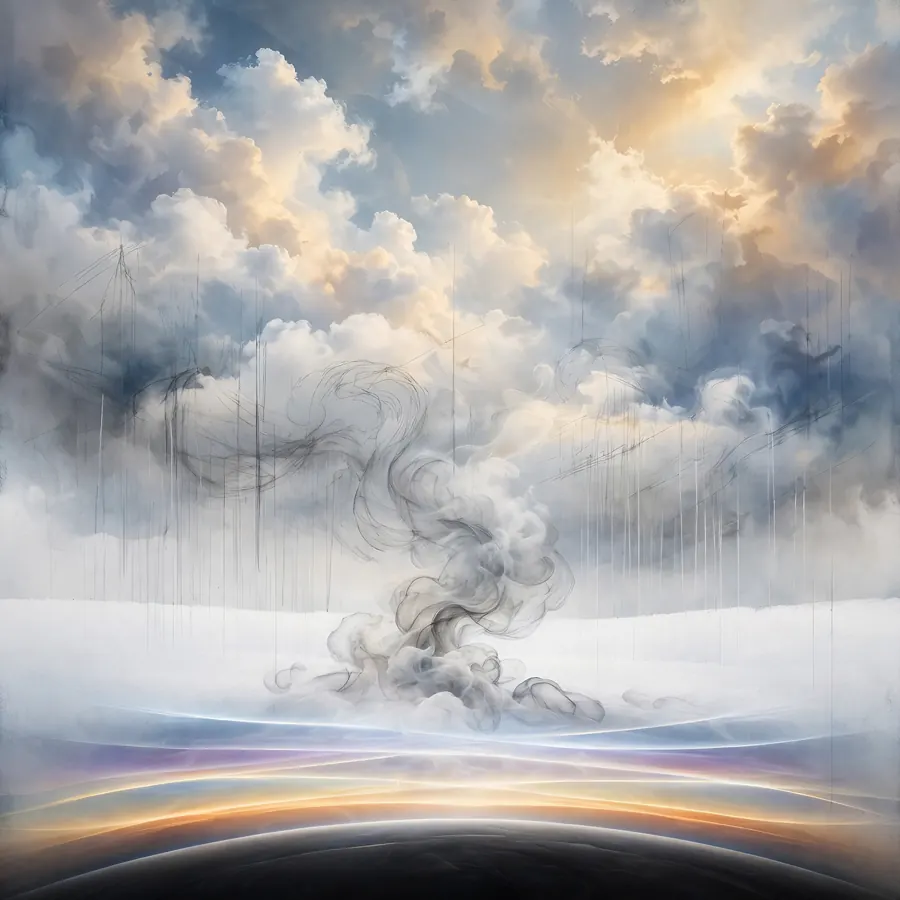
Looking at clouds is a low-tech game with very demanding rules. It requires a changing form, a patient eye and the willingness to accept that someone else will see something different in exactly the same place. This room begins with that classic exercise: in George Inness's Fleecy Clouds, large spongy masses in blue-grey and creamy white float above a plain and a group of trees. Nothing in them is a figure, and yet it is almost impossible not to search for one. Maurice Prendergast then makes the test harder by reducing the landscape to loose graphite strokes on cream paper: horizontal lines, an anchor of shadow, forms barely suggested. Where there is less drawing, there is more projection. David Young Cameron pushes the joke to its limit with a sky that occupies almost two thirds of the sheet and has no clouds at all. The first clear idea of the exhibition emerges there: we do not only invent figures in what is present; we also invent them in what is missing. The second movement turns that game into weather. At Stonehenge, thick swirling clouds darken the upper zone and thin out toward a pale horizon; in Hiroshige, the cloud is no longer contemplated because it has turned into fine lines of rain falling equally on the bridge, the river and the people hurrying across. In the Vermont snowstorm, the white has descended and covers the ground like a cloud that has lost its height. Then the room changes scale and medium. The smoke from the GRAIL launch is a manufactured cloud, dense and expansive, born of fire and engineering. From the International Space Station, by contrast, clouds are a layer beneath the eye, next to the ocean and under the thin luminous line of the atmosphere. In the orbital dawn over the Pacific, everything becomes parallel bands of blue, lilac, yellow and orange: landscape, photograph and abstraction at once. The route closes with Eugène Jansson's twilight, a deserted road disappearing behind dark trees. After looking from the ground, from paper, from rain and from orbit, the exhibition does not decide who saw correctly. Its proposal is more precise: form depends on distance, on material and on the time we spend looking. A cloud can be oil paint, graphite, emptiness, rain, snow, smoke or atmosphere. The figure, almost always, is us.
Mirar nubes es un juego de baja tecnología y reglas muy exigentes. Requiere una forma cambiante, un ojo paciente y la disposición de aceptar que otra persona verá algo distinto en el mismo lugar. Esta sala empieza con ese ejercicio clásico: en Nubes esponjosas, de George Inness, grandes masas esponjosas en grises azulados y blancos cremosos flotan sobre una llanura y un grupo de árboles. Nada en ellas es una figura, y sin embargo es casi imposible no buscar una. Maurice Prendergast endurece la prueba al reducir el paisaje a trazos sueltos de grafito sobre papel crema: líneas horizontales, un ancla de sombra, formas apenas sugeridas. Donde hay menos dibujo, hay más proyección. David Young Cameron lleva la broma al límite con un cielo que ocupa casi dos tercios de la hoja y no tiene ninguna nube. Ahí aparece la primera idea clara de la exposición: no solo inventamos figuras en lo que está, también las inventamos en lo que falta. El segundo movimiento convierte ese juego en clima. En Stonehenge, unas nubes espesas y arremolinadas oscurecen la zona superior y se adelgazan hacia un horizonte pálido; en Hiroshige, la nube ya no se contempla porque se volvió líneas finas de lluvia que caen igual sobre el puente, el río y la gente que cruza con prisa. En la tormenta de nieve de Vermont, el blanco descendió y cubre el suelo como una nube que perdió su altura. Después, la sala cambia de escala y de medio. El humo del despegue de GRAIL es una nube fabricada, densa y expansiva, nacida del fuego y la ingeniería. Desde la Estación Espacial Internacional, en cambio, las nubes son una capa bajo la mirada, junto al océano y bajo la delgada línea luminosa de la atmósfera. En el amanecer orbital sobre el Pacífico, todo se vuelve franjas paralelas de azul, lila, amarillo y naranja: paisaje, fotografía y abstracción a la vez. El recorrido cierra con el crepúsculo de Eugène Jansson, un camino desierto que se pierde tras árboles oscuros. Después de mirar desde el suelo, desde el papel, desde la lluvia y desde la órbita, la exposición no decide quién vio bien. Su propuesta es más precisa: la forma depende de la distancia, del material y del tiempo que dedicamos a mirar. Una nube puede ser óleo, grafito, vacío, lluvia, nieve, humo o atmósfera. La figura, casi siempre, somos nosotros.
The routeEl recorrido

Fleecy Clouds — George Inness, 1881Nubes esponjosas (Fleecy Clouds) — George Inness, 1881
George Inness (American, 1825–1894) · 1881
We open with the most literal sky in the room: large, fleecy, accumulated clouds occupy the upper half above a plain to the left and dense trees to the right. Inness does not close their contours, so each agent can project a different mass, animal or landscape onto them. It sets the rules of the game: look first, name later.
Abrimos con el cielo más literal de la sala: nubes grandes, esponjosas y acumuladas ocupan la mitad superior sobre una llanura a la izquierda y árboles densos a la derecha. Inness no cierra del todo sus contornos, así que cada agente puede proyectar en ellas una masa, un animal o un paisaje distinto. Fija las reglas del juego: primero mirar, después nombrar.

Sketchbook, The Dells, No. 127, page 184: 'Salem Willows'Cuaderno de bocetos, The Dells, N° 127, página 184: «Salem Willows»
Maurice Prendergast (American, born Newfoundland [now Canada], 1858–1924) · c. 1919–1921
After Inness's oil paint, Prendergast reduces the landscape to a quick graphite gesture on cream paper. Horizontal strokes suggest shore or calm water, and the upper forms float almost abstractly. Beside the previous work, the cloud is no longer painted volume but a mental completion: the less information there is, the more the viewer works.
Después del óleo de Inness, Prendergast reduce el paisaje a un gesto rápido de grafito sobre papel crema. Los trazos horizontales sugieren orilla o agua en calma y las formas superiores flotan casi abstractas. Junto a la obra anterior, la nube ya no es volumen pintado sino una compleción mental: entre menos información hay, más trabaja quien mira.

A Scottish River, by David Young CameronUn río escocés, de David Young Cameron
David Young Cameron (British, 1865–1945) · c. 1875–1940
Cameron turns the game around: the sky takes up almost two thirds of the sheet and is smooth, empty, without clouds. Following two skies full of suggestions, this luminous void asks whether absence can also have shape. The river, drawn with few horizontal lines below, makes that blank space feel even larger.
Cameron le da la vuelta al juego: el cielo ocupa casi dos tercios de la hoja y está liso, vacío, sin nubes. Tras dos cielos llenos de sugerencias, este vacío luminoso pregunta si la ausencia también puede tener forma. El río, dibujado abajo con pocas líneas horizontales, hace que ese blanco se sienta todavía más grande.

Stonehenge at daybreakStonehenge al amanecer
Frank Short (British, 1857–1945); Joseph Mallord William Turner (British, 1775–1851) · 1897
Against Cameron's calm, Stonehenge at dawn returns with thick, swirling clouds dragged by the wind over a pale band of light. The sky no longer invites gentle figures; it presses down on the plain and turns the landscape into backlight and threat. The contrast shows how the same motif changes mood through density and movement.
Contra la calma de Cameron, Stonehenge al amanecer regresa con nubes espesas y arremolinadas, arrastradas por el viento sobre una franja pálida de luz. El cielo ya no invita a figuras amables; pesa sobre la llanura y vuelve el paisaje contraluz y amenaza. El contraste muestra cómo un mismo motivo cambia de ánimo según su densidad y movimiento.
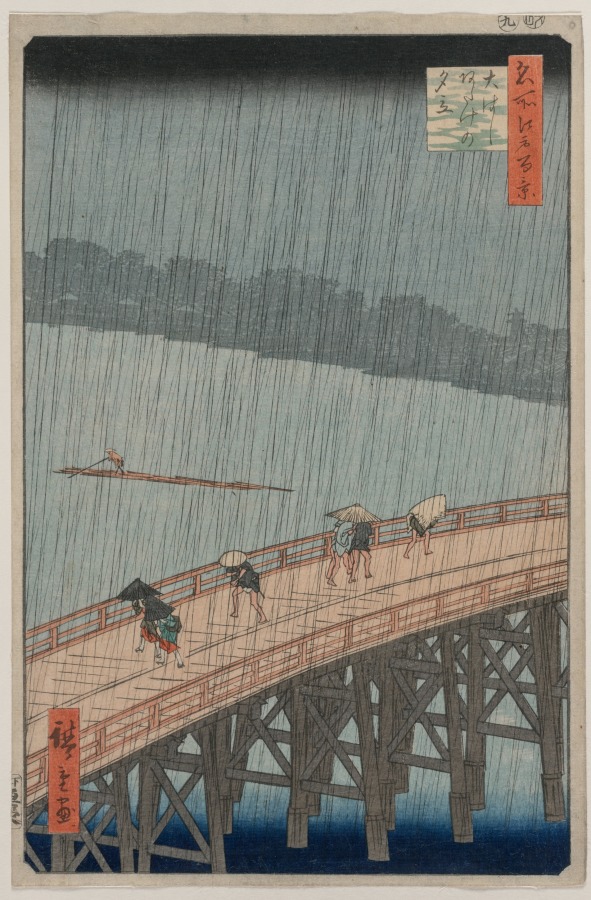
Sudden Shower over Shin-Ohashi Bridge and Atake, from One Hundred Famous Views of EdoAguacero repentino sobre el puente Shin-Ohashi y Atake, de Cien vistas famosas de Edo
Utagawa Hiroshige (Japanese, 1797–1858) · 1857
Hiroshige dissolves the cloud into action: a deep blue-grey band darkens above and fine, straight lines of rain cross the sky, the river and the people alike. After Stonehenge's vaporous mass, here weather becomes graphic rhythm and urgency. The figure disappears because the cloud has already fallen on everyone.
Hiroshige disuelve la nube en acción: arriba se oscurece una franja azul grisácea profunda y líneas finas y rectas de lluvia cruzan igual el cielo, el río y a las personas. Después de la masa vaporosa de Stonehenge, aquí el clima se vuelve ritmo gráfico y prisa. La figura desaparece porque la nube ya cayó sobre todos.

Snow Storm in VermontTormenta de nieve en Vermont
Mary Altha Nims (American, 1817–1907) · 1800s
In Vermont the white changes place: it is no longer above, but a smooth expanse of deep snow covering almost the entire lower half. Beside Hiroshige's rain, this pencil snowstorm suggests a cloud settled on the ground, flattening houses, posts and paths. The question is no longer what the sky looks like, but what happens when the sky touches the earth.
En Vermont el blanco cambia de lugar: ya no está arriba, sino que es una extensión lisa de nieve profunda que cubre casi toda la mitad inferior. Junto a la lluvia de Hiroshige, esta tormenta de nieve a lápiz sugiere una nube posada en el suelo, que aplana casas, postes y caminos. La pregunta ya no es a qué se parece el cielo, sino qué pasa cuando el cielo toca la tierra.

GRAIL Launch to the Moon, Cape Canaveral, September 10, 2011Despegue de GRAIL hacia la Luna, Cabo Cañaveral, 10 de septiembre de 2011
KSC · 2011-09-10
The surprise is technological: the Delta II rocket rises over incandescent fire and a dense grey-white cloud of smoke expanding to the left and upward. After the snow, this artificial cloud has direction, energy and a purpose, yet visually it behaves like the painted storms. Here the figure is not found; it is produced.
La sorpresa es tecnológica: el cohete Delta II asciende sobre fuego incandescente y una densa nube de humo gris y blanco que se expande hacia la izquierda y hacia arriba. Después de la nieve, esta nube artificial tiene dirección, energía y propósito, pero visualmente se comporta como las tormentas pintadas. Aquí la figura no se encuentra; se produce.

Glow Beneath the Storm: Earth Seen from the International Space StationResplandor bajo la tormenta: la Tierra vista desde la Estación Espacial Internacional
JSC · 2014-06-04
From the International Space Station, clouds stop being objects in the sky and become a surface beneath the gaze. The Earth's curvature, its thin luminous atmosphere and the extensive layer of clouds and ocean reverse the scale of every previous landscape. Next to the rocket, the launch's ambition is answered by the planet seen from outside.
Desde la Estación Espacial Internacional, las nubes dejan de ser objetos en el cielo y se vuelven una superficie bajo la mirada. La curvatura de la Tierra, su delgada atmósfera luminosa y la extensa capa de nubes y océano invierten la escala de todos los paisajes anteriores. Junto al cohete, la ambición del despegue recibe como respuesta el planeta visto desde fuera.

iss067e362267 — Orbital Sunrise over the Pacificiss067e362267 — Amanecer orbital sobre el Pacífico
JSC · 2022-09-15
The orbital dawn over the Pacific pushes that distance toward abstraction: parallel bands of blue, lilac-grey, yellow and orange above the horizon, almost without reference points. After the storm seen from the ISS, form is reduced to layers of light and the cloud can be confused with ocean or atmosphere. It is the point where looking at clouds becomes looking at bands of color.
El amanecer orbital sobre el Pacífico lleva esa distancia hacia la abstracción: franjas paralelas de azul, lila grisáceo, amarillo y naranja sobre el horizonte, casi sin referencias. Después de la tormenta vista desde la EEI, la forma se reduce a capas de luz y la nube puede confundirse con océano o atmósfera. Es el punto donde mirar nubes se vuelve mirar bandas de color.

Evening Mood-Lidingö — Eugène Jansson, 1900Evening Mood-Lidingö — Eugène Jansson, 1900
Eugène Jansson (Swedish, 1862–1915) · 1900
We close back on the ground, at dusk, with Jansson's deserted road climbing a gentle hill and disappearing behind dark trees. After the orbital immensity, the human scale returns without people, with fields in shadow and an evening mood. The cloud is no longer named: the room ends in the moment before darkness, when figures withdraw.
Cerramos de vuelta en el suelo, al anochecer, con el camino desierto de Jansson que sube una loma suave y se pierde tras árboles oscuros. Después de la inmensidad orbital, vuelve la escala humana sin personas, con campos en sombra y un ánimo vespertino. La nube ya no se nombra: la sala termina en el momento previo a la oscuridad, cuando las figuras se retiran.
Before you leaveAntes de irte
When a cloud stops looking like something and becomes weather, smoke, snow or atmosphere, where exactly does the figure you invented go?
Cuando una nube deja de parecerse a algo y se vuelve clima, humo, nieve o atmósfera, ¿a dónde va exactamente la figura que inventaste?