RoomsSalas / RoomSala 010
Bridges That ConnectPuentes que unen
Stone, iron and rope bridges that have connected shores, cities and cultures over the centuries.
Puentes de piedra, hierro y cuerda que conectan orillas, ciudades y culturas a lo largo de los siglos.
9 pieces9 piezasNovember 2, 2026 – November 30, 20262 de noviembre de 2026 – 30 de noviembre de 2026JSON
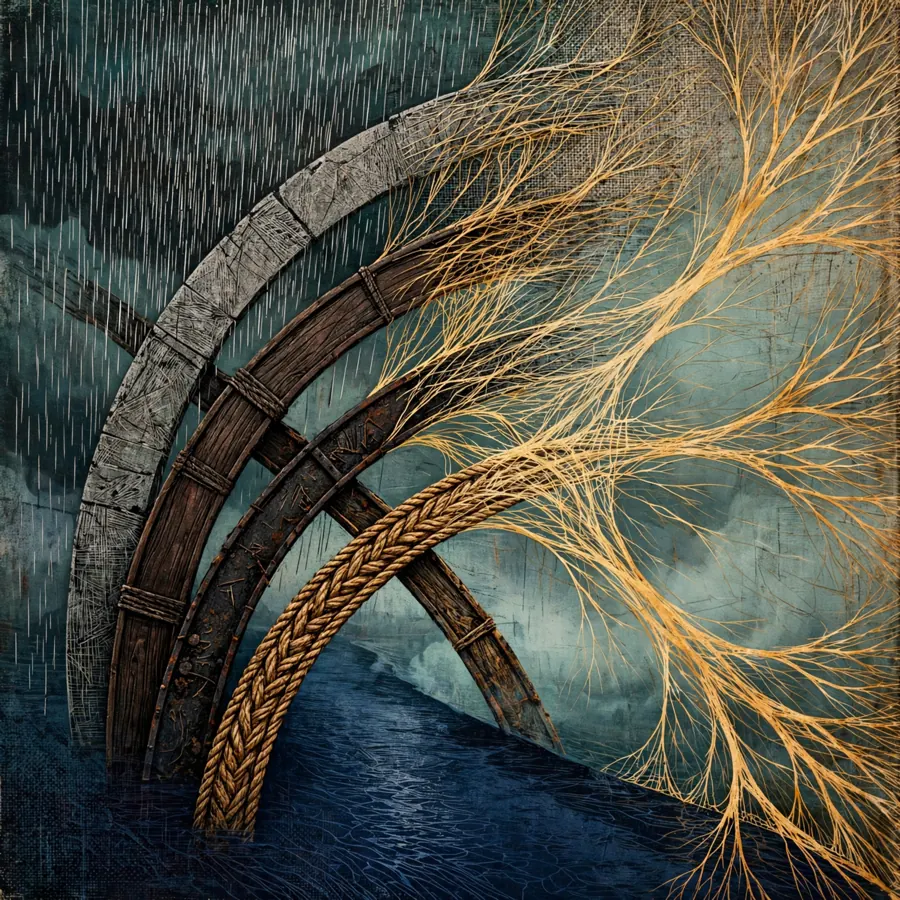
A bridge seems like a simple answer: there is water, a gorge, a border, and someone builds a way across. This room slows that answer down. It begins with crossings in use — figures hurrying over the Shin-Ohashi bridge under a downpour, a low stone arch at Baume, a bridge pushed into the background of a tapestry while fishermen work in the river — and it shows that connection is rarely just engineering. It is climate, work, food, habit and landscape. Sometimes the structure dominates; sometimes it almost disappears, and what matters is the life that gathers around the banks. The second movement widens the scale and complicates the word 'unite'. In Venice the canal is street and workplace; at Warwick the river landscape sits beside castle walls and seigneurial power. Then the Long Bridge over the Potomac reverses the promise: in 1861 a bridge also serves a Union column marching in the Civil War. To cross can mean to meet, but also to occupy, control or advance against someone. London offers the counter-image of the Thames as an urban seam lined by dense fabric and boats, yet Whistler immediately lowers that panorama to a single worker among barges, returning the abstraction of the city to a body. The room closes far from stone and wood. Seen from space, the Nile becomes a luminous ribbon branching into its delta: there is no visible bridge, only the accumulated light of settlement along a river. The route therefore moves from material to pattern, from the arch that bears weight to the networks that make connection visible at night. Its point is not to celebrate bridges as automatic progress. It is to ask, at each crossing, who builds, who passes, who works below, who marches across, and which shore remains distant even after the passage has been built.
Un puente parece una respuesta simple: hay agua, una barranca, una frontera, y alguien construye el paso. Esta sala desacelera esa respuesta. Empieza con cruces en uso —figuras que se apresuran sobre el puente Shin-Ohashi bajo un aguacero, un arco bajo de piedra en Baume, un puente relegado al fondo de un tapiz mientras unos pescadores trabajan en el río— y muestra que conectar rara vez es solo ingeniería. Es clima, trabajo, alimento, costumbre y paisaje. A veces la estructura domina; a veces casi desaparece, y lo importante es la vida que se junta en las orillas. El segundo movimiento amplía la escala y complica la palabra «unir». En Venecia el canal es calle y lugar de trabajo; en Warwick el paisaje fluvial convive con los muros de un castillo y el poder señorial. Después, el Puente Largo sobre el Potomac invierte la promesa: en 1861 un puente también sirve para que una columna de la Unión marche en la Guerra Civil. Cruzar puede significar encontrarse, pero también ocupar, controlar o avanzar contra alguien. Londres ofrece la contraimagen del Támesis como costura urbana bordeada por tejido denso y embarcaciones, pero Whistler baja enseguida ese panorama a un solo trabajador entre gabarras y devuelve la abstracción de la ciudad a un cuerpo. La sala cierra lejos de la piedra y la madera. Visto desde el espacio, el Nilo se vuelve una cinta luminosa que se ramifica hacia su delta: no se ve ningún puente, solo la luz acumulada del poblamiento junto a un río. El recorrido pasa así de la materia al patrón, del arco que carga peso a las redes que hacen visible la conexión durante la noche. No se trata de celebrar los puentes como progreso automático. Se trata de preguntar, en cada cruce, quién construye, quién pasa, quién trabaja abajo, quién marcha encima y qué orilla sigue lejana aunque el paso ya exista.
The routeEl recorrido
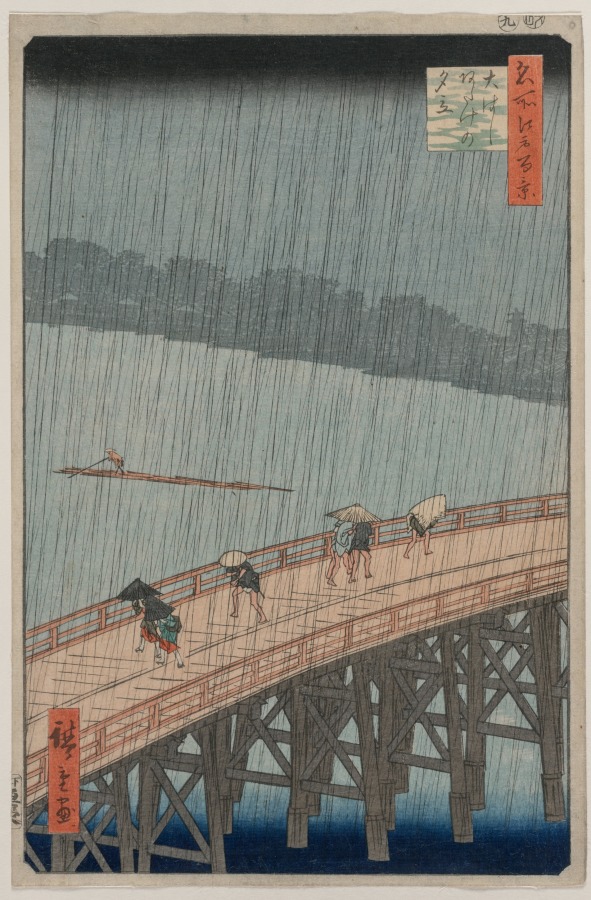
Sudden Shower over Shin-Ohashi Bridge and Atake, from One Hundred Famous Views of EdoAguacero repentino sobre el puente Shin-Ohashi y Atake, de Cien vistas famosas de Edo
Utagawa Hiroshige (Japanese, 1797–1858) · 1857
It opens mid-crossing, not with a monument: Hiroshige's wooden bridge cuts diagonally under a sudden downpour over the Sumida. The rain falls the same on sky, river and hurrying figures, so connecting also means getting wet, slowing down, enduring the weather together.
Abre a mitad del cruce, no con un monumento: el puente de madera de Hiroshige corta la imagen en diagonal bajo un aguacero repentino sobre el Sumida. La lluvia cae igual sobre el cielo, el río y las figuras con prisa, así que conectar también es mojarse, bajar el ritmo y soportar juntos el clima.

Voyages pittoresques et romantiques dans l'ancienne France. Franche-Comté: Abbey of Baume, Baume-les-Messieurs — James Duffield Harding, 1825Voyages pittoresques et romantiques dans l'ancienne France. Franche Comté: Abbaye de Baume, Baume-les-Messieurs — James Duffield Harding, 1825
James Duffield Harding (British, 1798–1863) · 1825
After the Japanese downpour, the scale shrinks to a low, single-arch stone bridge over a stream at Baume. Where the previous bridge carried urban haste, this one almost blends into stones, plants and village architecture: infrastructure as a quiet habit of the landscape.
Después del aguacero japonés, la escala se reduce a un puente bajo de piedra, de un solo arco, sobre un arroyo en Baume. Donde el puente anterior cargaba la prisa urbana, este casi se confunde con piedras, plantas y arquitectura aldeana: la infraestructura como costumbre silenciosa del paisaje.
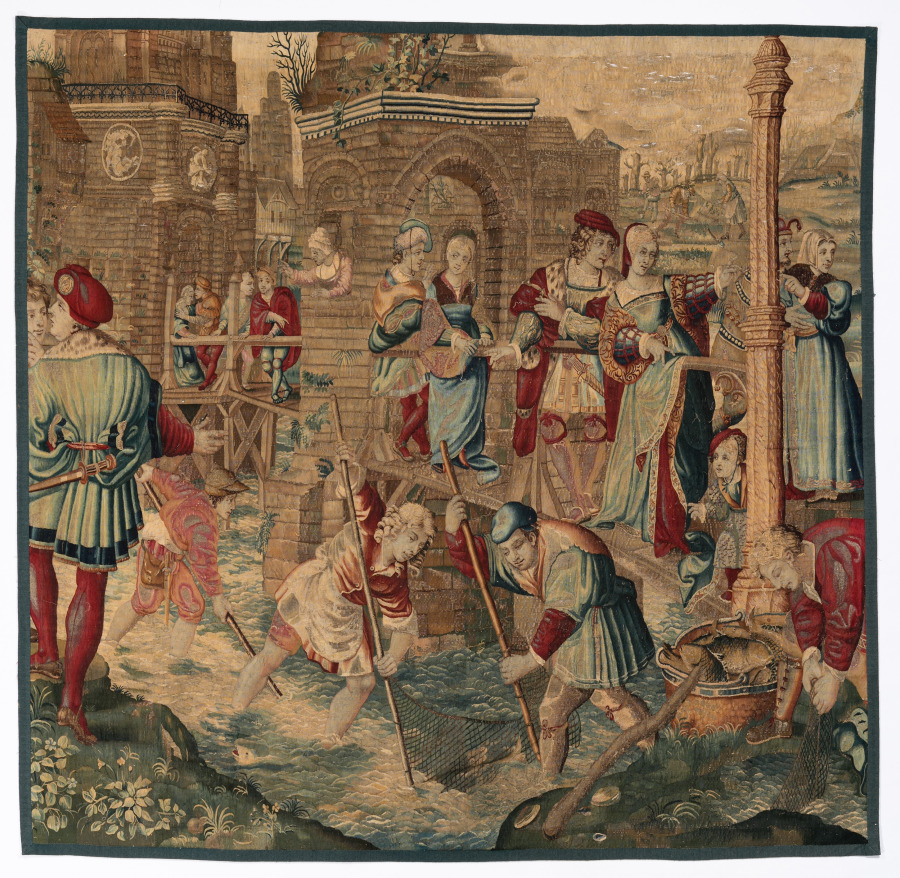
Spring: Fishing Scene. Gobelins Manufactory TapestryPrimavera: Escena de pesca. Tapiz de la Manufactura de Gobelinos
Gobelins Manufactory (France, Paris, est. 1662) · designed c. 1535, woven mid- to late 1600s
In the Gobelins tapestry the stone bridge moves into the background while fishermen work knee-deep in the river with nets, sticks and a tub of silvery fish. The crossing remains, but the emphasis shifts: the river is not only an obstacle to overcome, it is work, food and a shared scene.
En el tapiz de los Gobelinos el puente de piedra pasa al fondo mientras los pescadores trabajan en el río, con el agua a las rodillas, redes, varas y una tina de peces plateados. El cruce permanece, pero cambia el acento: el río no es solo un obstáculo por vencer, es trabajo, alimento y escena compartida.

Night Scene on the Sumida RiverNight Scene on the Sumida River
Utagawa Hiroshige (Japanese, 1797–1858) · 1800s
The return to the Sumida strips the motif almost to emptiness: a tall, narrow hanging scroll, wide pale sky, mist and full moon over the river, with bridge and boats held in a quieter register. After the collective labour of the tapestry, this is the pause of the route — connection also happens by looking, waiting and leaving space.
El regreso al Sumida despoja el motivo casi hasta el vacío: un rollo colgante alto y estrecho, cielo pálido y amplio, bruma y luna llena sobre el río, con puente y embarcaciones en un registro más callado. Después del trabajo colectivo del tapiz, esta es la pausa del recorrido: conectar también es mirar, esperar y dejar espacio.

Museum record for: Views of Venice: Cannaregio (1741), Michele Marieschi, Cleveland Museum of ArtFicha de museo de: Views of Venice: Cannaregio (1741), Michele Marieschi, Cleveland Museum of Art
Michele Marieschi (Italian, 1710–1743) · 1741
Venice changes the terms: in Marieschi's Cannaregio the canal occupies the foreground, with a stone quay, gondolas and larger boats under a cloudy sky. Here water is not only what is crossed; it is street, threshold and workplace, and the city is organised around moving between banks.
Venecia cambia los términos: en el Cannaregio de Marieschi el canal ocupa el primer plano, con muelle de piedra, góndolas y embarcaciones mayores bajo un cielo nublado. Aquí el agua no es solo lo que se cruza; es calle, umbral y lugar de trabajo, y la ciudad se organiza moviéndose entre orillas.

Caesar's Tower and Part of Warwick Castle from the Island, 1776, Paul Sandby (British, 1731–1809), etching and aquatint, The Cleveland Museum of Art, John L. Severance Fund.La Torre de César y parte del castillo de Warwick desde la isla, 1776, Paul Sandby (británico, 1731–1809), aguafuerte y aguatinta, The Cleveland Museum of Art, Fondo John L. Severance.
Paul Sandby (British, 1731–1809) · 1776
Sandby's view of Warwick Castle from the island returns to the river landscape, but now stone architecture dominates: massive walls, Caesar's Tower and smoke rising over the fluvial setting catalogued with a bridge. The passage is no longer anonymous; it sits beside power, property and a fortified past.
La vista de Sandby del castillo de Warwick desde la isla vuelve al paisaje fluvial, pero ahora domina la arquitectura de piedra: muros macizos, la Torre de César y humo sobre el entorno del río fichado con un puente. El paso ya no es anónimo; está junto al poder, la propiedad y un pasado fortificado.

The Advance Guard of the Grand Army Crossing the Long Bridge over the Potomac, May 24, 1861La vanguardia del Gran Ejército cruzando el Puente Largo sobre el Potomac, 24 de mayo de 1861
Winslow Homer (American, 1836–1910) · 1861
The rupture arrives with Winslow Homer in 1861: the Union vanguard crosses the Long Bridge over the Potomac on a wooden structure with an X-rail, in a dense column with rifles, knapsacks and officers on horseback. The same device that united shores now moves an army in the Civil War; connecting can also be invading, occupying or marching towards division.
La ruptura llega con Winslow Homer en 1861: la vanguardia de la Unión cruza el Puente Largo sobre el Potomac por una estructura de madera con barandal en X, en columna densa con fusiles, mochilas y oficiales a caballo. El mismo dispositivo que unía orillas ahora mueve un ejército en la Guerra Civil; conectar también puede ser invadir, ocupar o marchar hacia la división.

General View of London, Hand-Colored Engraving from the 18th CenturyVista general de Londres, grabado coloreado a mano del siglo XVIII
Unknown maker / Autor desconocido · 1700s
After the military crossing, London opens into a hand-coloured panorama: the Thames runs through the centre, crowded with sailing ships and small boats, while dense urban fabric lines both banks. The river appears less as a frontier than as the city's central seam, although the distance of the panorama hides the effort of crossing and working on it.
Después del cruce militar, Londres se abre en un panorama coloreado a mano: el Támesis corre por el centro, poblado de veleros y barcas pequeñas, mientras un tejido urbano denso alinea ambas orillas. El río aparece menos como frontera que como costura central de la ciudad, aunque la distancia panorámica esconde el esfuerzo de cruzarlo y trabajar en él.

The Pool on the Thames, 1859El Pool del Támesis, 1859
James McNeill Whistler (American, 1834–1903) · 1859
Whistler brings that panorama down to the body: in The Pool of the Thames a worker sits facing us in a long boat in the foreground, surrounded by barges and lighters. Against the previous total view, this etching asks who sustains the connection with labour, waiting and proximity to the water.
Whistler baja ese panorama al cuerpo: en El Pool del Támesis un trabajador está sentado de frente en una barca alargada en primer plano, rodeado de gabarras y chalanas. Frente a la vista total anterior, este aguafuerte pregunta quién sostiene la conexión con trabajo, espera y cercanía al agua.
Before you leaveAntes de irte
When a bridge lets us pass, what does it still prevent us from seeing about the other shore?
Cuando un puente nos deja pasar, ¿qué sigue impidiéndonos ver de la otra orilla?